Recruitment Marketing in 2026: Attract Better Candidates

74.4% of the talent market isn't looking at job boards right now. They're employed, not applying, and not easy to reach with a standard job post. Recruitment marketing is how you reach them before they're ready to move, so your company is already on their list when they are.
Why it matters now
- 83% of job seekers research company reviews before deciding where to apply. Your employer brand is shaping candidate decisions before any recruiter gets involved.
- Candidates who find you through authentic employer brand content are 38% less likely to leave within six months. They arrive knowing what they're getting into.
- Companies with strong employer brands report 50% more qualified applicants and 28% lower turnover. That return builds over time.
What actually drives results
- Your EVP is the foundation. Build it from real employee feedback, not what leadership wishes was true. A vague EVP produces vague recruitment marketing at every stage.
- Employee advocacy outperforms brand-produced content on trust. Employees are trusted three times more than employers when it comes to company messaging. Structured programmes that make sharing easy are one of the highest-ROI moves available.
- Passive candidates aren't on job boards. Niche newsletters, professional communities, and organic search are where they're paying attention. Meeting them there takes more planning but produces higher-intent pipeline.
- Programmatic ad placement is now standard for serious recruitment marketing. Platforms that automatically buy and optimise job ads based on real-time performance data cut wasted spend and surface the right candidates faster.
- 42% of candidates have left a hiring process because scheduling took too long. Candidate experience during the process feeds directly back into employer brand reputation.
Three metrics that tell you if it's working
- Application completion rate - Are candidates finishing what they start? A low rate usually points to a long form, a vague job description, or a broken mobile experience.
- Source of quality hire - Which channels produce candidates who convert and stay? This is more useful than cost-per-click or application volume.
- Six-month retention - Are new hires still there at the six-month mark? If not, the problem is often a mismatch between what recruitment marketing promised and what the job actually delivered.
The principle that runs through everything
Recruitment marketing isn't about generating more applications. It's about being visible and credible to the right people, long before they're ready to apply. The companies that build that consistently find each hire gets faster and cheaper as the brand compounds.
Only 25.6% of the reachable talent market is actively looking for a new
job at any given time. The other 74.4% are passive. They're employed, not
applying, and not browsing job boards. Reaching them takes a different
approach entirely. That's what recruitment marketing is for.
Organisations that invest in recruitment marketing build visibility with the wider talent market. So when the right candidate is ready to move, your company is already on their list. Today, 83% of job seekers research company reviews and ratings before deciding where to apply. Most say an employer's reputation directly influenced their decision to accept their current role. Your employer brand is already doing work. The question is whether it's doing it intentionally.
This guide covers what recruitment marketing is, how to build a strategy that gets stronger over time, and how to know if it's working.
What is Recruitment Marketing?
Recruitment marketing is the use of marketing techniques to promote the value of working at your organisation. It combines employer branding, content, paid advertising, and candidate experience into a proactive strategy for attracting talent before a role is even open.
Traditional recruiting is reactive. A role opens, a job post goes live, and you wait for applications. Recruitment marketing is different. It builds a pipeline of interested candidates continuously, so you're not starting from scratch every time a position opens.
The goal is simple: be known, trusted, and worth choosing by the people you most want to hire before they are even looking.
Why recruitment marketing matters in 2026?
The talent market in 2026 is more competitive and more candidate-researched than it has ever been. Here is why recruitment marketing has become a baseline requirement rather than a nice-to-have:
1. Reaches candidates before they are looking
The majority of the workforce isn't updating their CV or browsing job boards. Reaching them requires brand presence and content that earns attention before any job ad does.
2. Reduces cost-per-hire over time
Companies with strong employer brands report 50% more qualified applicants and 28% lower turnover. That return compounds the longer you invest. It consistently outperforms reactive job board spend over the medium term.
3. Improves retention instead of applications
Candidates who find and apply through authentic employer brand content are 38% less likely to leave within the first six months, compared to those sourced through transactional job board postings. They arrive with calibrated expectations.
4. Shortens time-to-hire
A pre-built pipeline of warm candidates means sourcing work is already done when a role opens. You're not cold-starting every search.
5. Shapes candidate decisions before a recruiter gets involved
Employer brand, job content, and social presence now influence candidates before any outreach happens. Your brand needs to be consistent and credible at every touchpoint.
Core Components of Recruitment Marketing
Effective recruitment marketing combines several elements that work together across the candidate journey.
1. Employer Branding - The perception of your company as a place to work. Built through culture, values, and real employee experience. Everything else in recruitment marketing sits on top of this.
2. Content Marketing - Blogs, employee stories, behind-the-scenes content, and thought leadership give candidates a genuine view of what working at your company looks like. This is what fills the gap between "I've heard of them" and "I'd apply there."
3. Recruitment Advertising - Paid campaigns on LinkedIn, Indeed, and Glassdoor extend your reach to specific candidate profiles and skills. AI-powered programmatic ad placement is increasingly standard here, automating which ads appear to which candidates based on role fit and browsing behaviour.
4. Social Media - Organic presence on LinkedIn, Instagram, and niche professional communities is where your target candidates spend time. Consistency here builds familiarity that paid ads alone can't produce.
5. Candidate Experience - How candidates feel at every stage from first contact to offer. Over half of job seekers will share a negative candidate experience online, and over three-quarters will share a positive one. Candidate experience is a direct input to employer brand reputation. For a deeper look at how automation affects this, Enhancing Candidate Experience with Recruitment Automation covers this in detail.
6. Employee Advocacy - Employees are trusted three times more than employers when it comes to company messaging. Structured programmes that make it easy for employees to share their experiences are one of the highest-ROI channels in recruitment marketing, particularly for technical roles where trust signals matter most.
Employer Branding and EVP
Employer branding is the reputation your organisation holds in the minds of candidates and employees. It comes from your culture, leadership, work environment, and how people actually talk about working there.
Recruitment marketing is how you communicate and amplify that brand.
Think of employer branding as what you are. Recruitment marketing is how you show it.
A strong employer brand starts with a clear Employer Value Proposition (EVP). An EVP is a specific, honest answer to why someone should work at your company over every other company competing for the same person. The most effective EVPs come from real employee interviews and honest feedback, not aspirational statements written by a marketing team.
Once your EVP is defined, it should run consistently across every channel. Your careers page, job descriptions, social media profiles, employee testimonials, and the way your recruiters talk about a role in first conversations should all reflect the same thing.
The Recruitment Marketing Funnel
The recruitment marketing funnel maps the journey a candidate takes from first hearing about your company to accepting an offer. Each stage requires a different type of engagement.
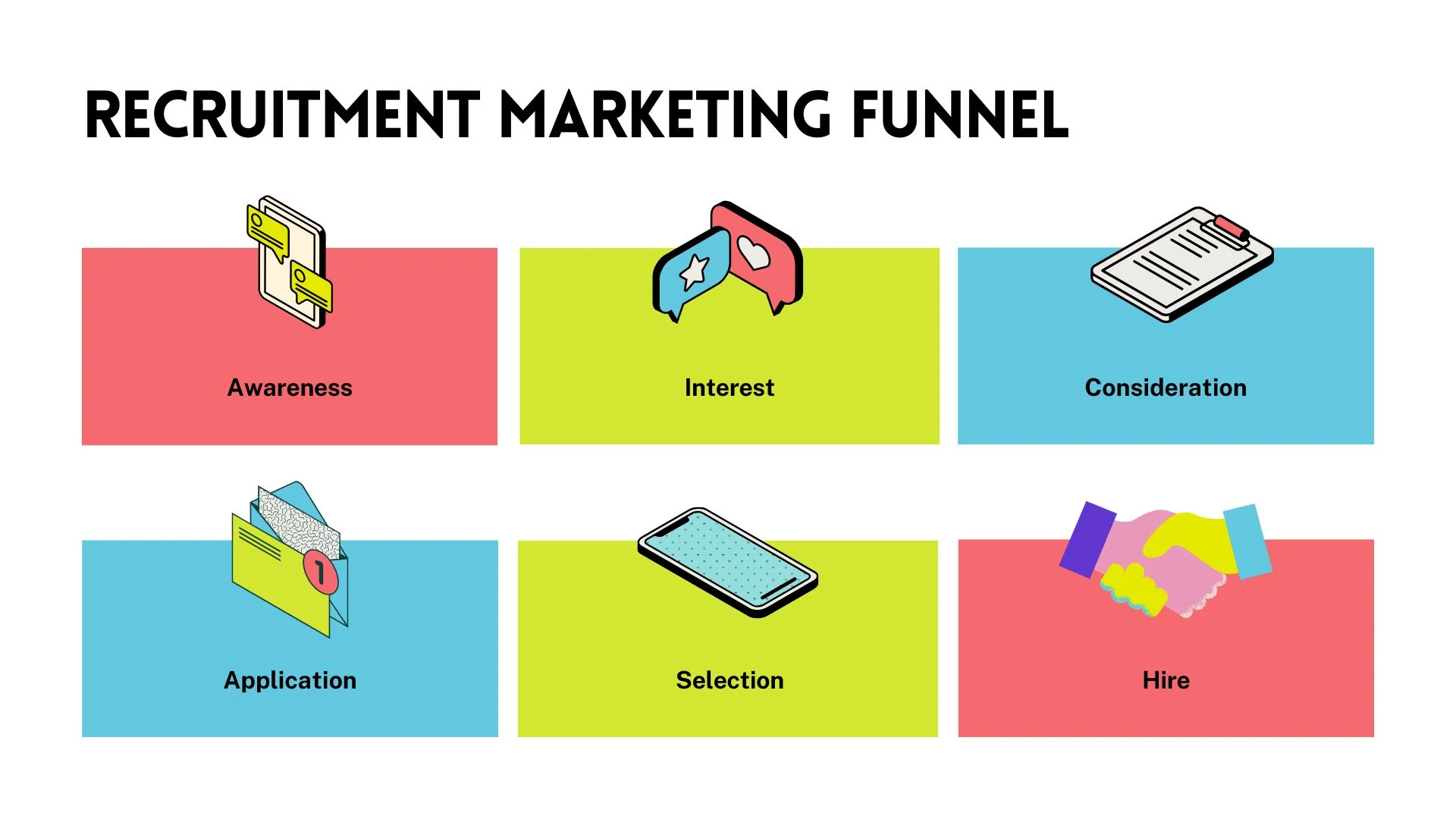
1. Awareness
In the awareness stage, the focus is on attracting potential candidates and making them aware of your company as a desirable employer. Candidates learn your company exists as an employer.
Channels: Social media, content, employer review sites, job boards, paid advertising
Goal: Make your brand recognisable and appealing before any role is open
2. Interest
In the interest phase, potential candidates become curious about your company and begin actively exploring what you offer.
Channels: Careers page, LinkedIn company page, employee content, newsletters
Goal: Give them enough to want to learn more
3. Consideration
In the consideration stage, candidates are seriously weighing the possibility of applying for a job at your company. At this point, they are likely comparing you to other potential employers.
Channels: Detailed job descriptions, culture content, team pages, employee testimonials
Goal: Give them the specific information they need to decide to apply
4. Application
The application phase is when candidates take the important step of submitting their resumes and formally expressing interest in a position. Recruitment marketing at this stage involves streamlining the application process to reduce friction.
A streamlined application process: Short forms, clear next steps, mobile-friendly. It directly affects how many strong candidates make it through. Every unnecessary field in an application form is an exit opportunity for a qualified candidate.
Channel: Simple online form or an integrated ATS (Applicant Tracking System)
5. Selection
In the selection phase, your hiring team assesses and evaluates the candidates. Recruitment marketing still plays a role here. The prompt communication, transparency about timelines, and respectful feedback keep candidates engaged and protect your employer brand regardless of the outcome.
Keeping an open line of communication helps strengthen your employer brand and allows you to maintain relationships for future roles.
6. Hire and Onboarding
A candidate accepts the offer and joins. The recruitment marketing job is not finished at the offer stage. Onboarding content, first-week communication, and delivering on the promises made during recruitment are what convert a new hire into an advocate. They then feed back into the awareness and interest stages for future candidates.
Candidate nurturing runs across all six stages. Like lead nurturing in sales, it means maintaining contact with candidates who aren't ready to apply yet, through newsletters, talent communities, and content that keeps your company relevant until the timing is right.
Recruitment Marketing vs Employer Branding: What's the Difference?
These two terms are closely related, and it's easy to use them interchangeably. But they're distinct.
Employer Branding is the reputation and image of your company as an employer. It's how candidates and employees perceive you, based on your culture, values, and the real experience of working there. It's built over time through what your company actually does, not what it says.
Recruitment Marketing is the set of strategies and channels you use to communicate and amplify that brand. It includes targeted advertising, social media campaigns, content production, and talent community management.
Employer branding is the foundation. Recruitment marketing is the work you do on top of it.
The distinction matters because you can run recruitment marketing campaigns with a weak employer brand. But the results will always be limited. Candidates will research beyond your ads, and what they find will determine whether they apply.
Key Differences
How to Build a Recruitment Marketing Strategy
Step 1: Define your Employer Value Proposition (EVP)
Your EVP is the specific reason a candidate should choose you over every other company competing for the same person. It should be built from real employee feedback. What people actually value about working there, instead of what leadership wishes they valued. Test it with current employees before publishing it externally.
Step 2: Build candidate personas
Define who you are trying to reach for each role family. Map their motivations, the platforms they use, the career concerns they have, and the signals they trust. A senior engineer and an early-career data scientist have different information needs and different reasons to move. Treat them as separate audiences.
Step 3: Prioritise your channels
Social media now outshines traditional job boards for employer branding reach, with 98% of hiring teams using it. But job boards remain relevant for active job seekers. The right channel mix depends on your role type and candidate seniority. Allocate budget based on where your target personas actually spend time, not where competitors default to.
Step 4: Build a content calendar
Consistency matters more than volume. A regular cadence of employee stories, role spotlights, culture content, and company updates keeps your brand present in candidates' feeds. Employee-generated content performs better on authenticity metrics than brand-produced content, making it easy for your team to contribute.
Step 5: Optimise candidate experience at every touchpoint
Audit every stage of your process from first ad impression to offer letters for unnecessary friction and delays. 42% of candidates have left the recruitment process because it took too long to schedule an interview.
Step 6: Measure and reallocate
Track source-of-hire by channel, application completion rates, and offer acceptance rates quarterly. Reallocate budget toward channels that produce quality hires, not just application volume. This is the step most teams skip and the reason recruitment marketing budgets get cut.
Conclusion
Recruitment marketing is a commitment to being visible, credible, and worth choosing before a candidate ever sees your job posting. The companies that build this consistently find that each hire gets cheaper and faster as the brand builds. Each new hire who becomes an advocate makes the next search easier.
Start with the EVP. Get your careers page and LinkedIn presence to a solid baseline. Then track three metrics: application completion rate, offer acceptance rate, and six-month retention. Everything else paid advertising, content programmes, talent communities builds on that foundation.
Scaling a technical team and want a recruiting partner with incentives aligned to outcomes rather than placements? Recrew works on a no-hire, no-fee model. From AI-led sourcing, deep role briefing, and pre-offer intent conversations built for software engineering, AI/ML, and product hiring.
FAQs
1. What is the difference between recruitment marketing and traditional recruiting?
Traditional recruiting is reactive. A role opens and you search for candidates. Recruitment marketing is proactive. You build awareness and relationships with candidates before a role exists, so your pipeline is warm when you need it. The former fills individual roles. The latter builds a talent engine that gets more efficient over time.
2. How long does it take to see results from a recruitment marketing strategy?
Paid channels like job board advertising can show results within weeks. Employer brand and content marketing typically take three to six months to build meaningful pipeline impact. The compounding effect, where brand recognition reduces sourcing effort over time, becomes visible at the six-to-twelve-month mark.
3. Do small companies or startups need recruitment marketing?
In some ways, more than large ones. Startups can't compete on salary alone. They need to win on culture, mission, and growth opportunity, and recruitment marketing is how you communicate those things at scale without a large TA team. A strong careers page and consistent LinkedIn presence go a long way at an early stage.
4. What is an Employer Value Proposition, and do we really need one?
Your EVP is the honest answer to why someone should work for you over anyone else competing for the same person. Without it, your recruitment marketing has no consistent message. Content, ads, and job descriptions all pull in different directions. It doesn't need to be elaborate. It needs to be true and specific.
5. How do we measure whether our employer brand is working?
Track three things: application completion rate (are candidates finishing what they start), offer acceptance rate (are candidates saying yes), and six-month retention (are new hires still there). If all three improve after you invest in employer branding, it's working.