
Salary Calculator
What is theAI Research Engineersalary in India?
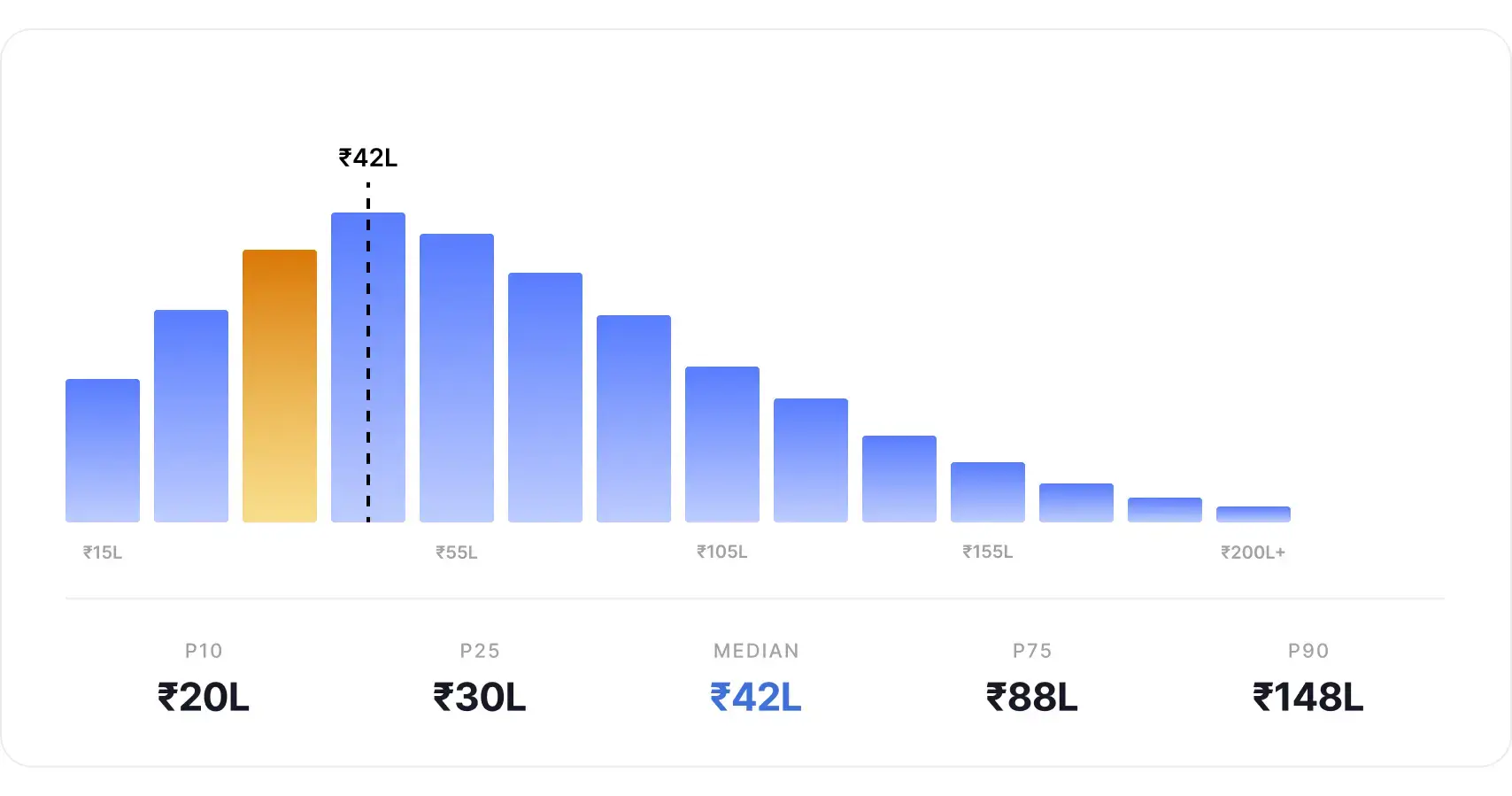
Salary range: ₹15 LPA to ₹2 Cr+
AI Research Engineers have the steepest salary ceiling of any technical role in India. The market runs from ₹15 LPA for entry-level research roles at well-funded startups to ₹2 Cr or more for principal research scientists at FAANG AI labs.
Quick salary snapshot
- Entry level (0-3 years): ₹15 to 30 LPA at well-funded AI startups
- Mid-level (3-5 years): salary diverges sharply from general AI/ML engineering here
- Senior Research Scientist (8-12 years): ₹80 LPA to ₹1.5 Cr at Google DeepMind, Microsoft Research, and Meta AI India
- Principal Research Scientist (12+ years): ₹2 Cr and above
What moves the number
- Published work at NeurIPS, ICML, CVPR, or ACL directly affects offer levels at FAANG labs and semiconductor firms
- A PhD is near-mandatory for pure research-track roles at FAANG labs. Master's graduates with published work can enter at ₹20 to 30 LPA
- Foundation-model training, alignment research, and multimodal AI are the highest-paid research domains
- AI safety, reasoning, and agentic AI are seeing the fastest salary growth in 2026
- RSU vesting is where most of the compensation gap lives at senior levels. Base salary alone rarely crosses ₹60 to 70 LPA
Who's hiring
FAANG AI labs, GCC R&D divisions, and well-funded AI-first startups. This is a concentrated employer market. The number of companies that can genuinely support research-track careers in India is small, which is part of what keeps salaries high at the top end.
AI Research Engineer Salary Range in India; 2026 Breakdown
AI Research Engineers design novel model architectures, run experiments, publish at top venues (NeurIPS, ICML, CVPR, ACL), and ship those innovations into working systems. In 2026, the Indian market ranges from ₹15 LPA for entry-level research roles at well-funded startups. To ₹2 Cr+ for principal research scientists at FAANG AI labs.


.svg)
.svg)
AI Research Engineer Salary by Experience Level in India
AI Research Engineers have the steepest salary ceiling of any technical IC role in India. The trajectory diverges sharply from general AI/ML engineering at the 3-5 year mark. At the senior and principal levels, compensation at FAANG India AI labs approaches or exceeds US-adjusted figures on a PPP basis.

Which Industries Pay AI Research Engineers the Most in India?
AI research labs and foundation-model companies set the absolute ceiling. They need engineers who can advance the state of the art while also building scalable systems. The employer landscape for this role is concentrated in FAANG labs, GCC R&D divisions, and well-funded AI-first startups.
Location-wise Salary of AI Research Engineers
For AI Research Engineering, the location story is simpler and more concentrated. Bengaluru is the only city with meaningful depth across FAANG AI labs, AI-first startup research teams, and GCC R&D divisions. Hyderabad is a strong second for GCC research. Remote roles for US-based AI research labs pay at US-adjusted benchmarks.

Related Roles
Similar roles you might consider

What Affects Pay
What influences anAI Research Engineersalary
Six factors explain most of the variance inAI Research Engineer in India. Mix matters more thanany single one.

Publication Record & Research Novelty
Engineers with accepted papers at tier-1 venues earn 30-50% more. At FAANG labs, a publication record is nearly a prerequisite for senior and principal bands. One strong first-author paper at a top venue can shift a mid-level offer from ₹30 LPA to ₹45 LPA.

Employer Type
FAANG AI labs pay the absolute ceiling 2-3x what AI-first startups pay for the same experience level. Tier-1 GCC R&D divisions sit in between. The premium reflects access to research infrastructure that only a handful of labs can offer.

Location & Compute Access
Bangalore is the only Indian city with a full research infrastructure ecosystem. Hyderabad is closing the gap for GCC research, but Bangalore's network effects for startup and frontier research remain unmatched.

Research Domain
Foundation-model training, alignment research, and multimodal AI are the highest-paid research sub-domains. Computer vision and NLP at scale also command premiums. Emerging domains, like AI safety, reasoning, and agentic AI, are seeing the fastest salary growth.

PhD vs. Non-PhD
For pure research-track roles at FAANG labs, a PhD from a strong program is near-mandatory. Master's graduates with published work and production experience can enter at ₹20-30 LPA. The PhD premium (15-30% at entry) narrows by the 5-year mark.

Production Systems
The highest-paid research engineers are those who publish and build. Engineers who can design a novel architecture, validate it experimentally, and ship the system to production at scale are rare. This combination is what separates ₹50 LPA from ₹1 Cr+ at 8-10 years.
Frequently Asked Questions
AI Research Engineers design novel methods, new model architectures, training techniques, or evaluation approaches, and build the systems to validate and deploy them. ML Engineers focus on applying existing methods to production problems. Data Scientists focus on analysis, experimentation, and insight generation. This is why the role pays 30-50% more than general ML engineering at equivalent experience.
At FAANG AI labs, a PhD or equivalent published body of work is near-mandatory for research scientist roles. At product companies, GCC R&D divisions, and AI startups, a Master's degree with strong publications and production experience can suffice.
PhD graduates from strong programs entering FAANG India labs start at ₹25-35 LPA. Master's graduates with publications entering GCC R&D start at ₹15-25 LPA. AI-focused startups offer ₹15-22 LPA base + equity for entry-level research engineers.
Yes, Senior Research Scientists (8-12 years) at Google DeepMind, Microsoft Research, and Meta AI India reach ₹80 LPA-₹1.5 Cr total comp. Principal and Distinguished Research Scientists (12+ years) can exceed ₹2 Cr. These figures include significant RSU vesting base salary alone rarely crosses ₹60-70 LPA.
In order of compensation ceiling:
(1) Foundation-model training and post-training;
(2) Multimodal AI (vision-language models, video generation);
(3) LLM inference optimization and serving infrastructure;
(4) Computer vision at scale (autonomous systems, medical imaging);
(5) AI safety and interpretability are emerging but growing fast due to regulatory and enterprise interest.
