
Salary Calculator
What is theNLP Engineersalary in India?
Salary range: ₹22 LPA to ₹80 LPA
NLP Engineer salaries in India range from ₹22 LPA to ₹80 LPA in 2026, with most active hiring happening in the 3 to 8 year experience band. What you work on matters as much as how long you've worked.
Two tracks, two pay levels
- Classic NLP (text classification, information extraction, fine-tuning models on specific data): ₹8 to 35 LPA depending on seniority
- Applied LLM (retrieval systems, RAG pipelines, prompt-driven product features): commands a premium over classic NLP at every level, with senior roles reaching ₹70 to 80 LPA
The difference between the two tracks isn't just pay. The day-to-day work is genuinely different. Classic NLP engineers build and fine-tune models on structured tasks. Applied LLM engineers build on top of existing large models and own retrieval and evaluation systems.
What moves the number
- Applied LLM skills earn more than classic NLP skills at the same seniority, because demand for them has grown faster than supply
- Company type is the second biggest variable. Product companies and GCCs pay significantly more than IT services firms for the same title
- Bengaluru and Hyderabad are the strongest markets for NLP hiring, driven by GCCs and AI-first startups
NLP Engineer vs LLM Engineer
These roles overlap but aren't the same. LLM Engineers top out slightly higher because of the fine-tuning and RAG specialisation premium. If your work sits closer to building retrieval systems and production LLM features, the LLM Engineer title and band may be more accurate.
NLP Engineer Salary in India: 2026 Breakdown
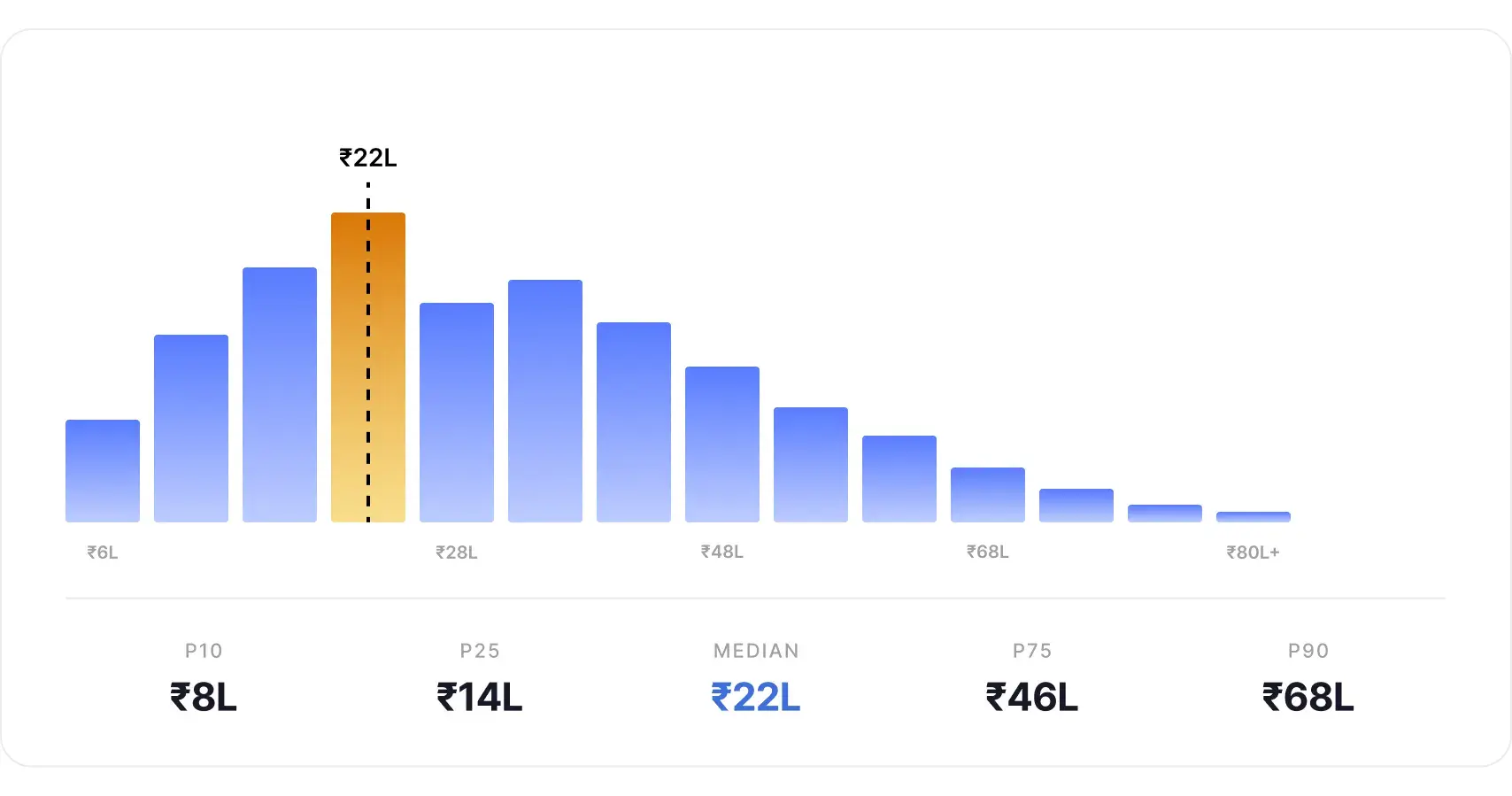
NLP Engineers in India earned between ₹6 LPA and ₹80 LPA+ in 2026. That range comes down to one factor: if you work in legacy NLP or LLM-based roles. IT services firms hire at the lower end for traditional pipeline work. Product-first companies and FAANG AI labs pay the highest salaries for engineers who fine-tune foundation models, build RAG pipelines, and ship LLM-powered features.


.svg)
.svg)
Experience-wise NLP Engineer Salary in India 2026
NLP has some of the steepest salary growth curves in Indian AI. The talent pool of engineers who can work with transformers and LLMs at production scale remains thin. Senior NLP engineers who combine model-level depth with production deployment skills are among the scarcest technical profiles in the market.

Which Industries Pay NLP Engineers the Most in India?
Every industry that processes language at scale is hiring NLP engineers in 2026, but the premiums vary sharply. AI-first product companies and FAANG labs pay the most because NLP output directly powers revenue-generating features: search, recommendations, content generation, and customer-facing chatbots.
Location-wise Salary of NLP Engineers
Bengaluru pays the highest for NLP roles, driven by the density of AI research labs, GenAI startups, and GCC R&D teams. Chennai is a notably strong market for NLP, specifically, Zoho, Freshworks, and the IIT Madras research ecosystem. Remote roles for US/EU-based AI companies pay at benchmarks or above, regardless of the engineer's city.

Related Roles
Similar roles you might consider

What Affects Pay
What influences anNLP Engineersalary
Six factors explain most of the variance inNLP Engineer in India. Mix matters more thanany single one.

Years of Experience
Steep jumps at the 2-year and 5-year marks. Entry: ₹8-12 LPA at product companies. Mid-level (2-5 years): ₹18-30 LPA. Senior (5-8 years): ₹35-55 LPA. At 8+ years, NLP leads at GCCs reach ₹60-80 LPA.

Company Type
Product companies and GCCs pay 60-150% more than IT services firms at equivalent experience. IT services’ NLP roles are typically API integration. Product company NLP roles involve training custom models, building evaluation pipelines, and owning language features end-to-end.

Location
Bangalore pays 20-30% above the national NLP average. Chennai is an unusually strong NLP market due to tech ecosystem. Hyderabad is within 5-10% of Bangalore for GCC NLP roles. Remote roles for global employers pay at Bangalore benchmarks regardless of city.

Specialization Depth
LLM post-training and alignment (RLHF, DPO, supervised fine-tuning), search relevance engineering, multilingual NLP (particularly Indian-language models), and conversational AI platform architecture. Sentiment analysis and basic text classification now sit at the lower end.

LLM-era vs. Legacy NLP Skills
Engineers who work with transformers, LLM fine-tuning, RLHF/DPO, RAG pipelines, and production LLM serving earn 30-50% more. The market has bifurcated: pre-transformer NLP skills are commoditized; post-transformer NLP skills carry steep premiums.

Research + Deployment
The ideal and highest-paid profile combines both: published research depth with a track record of shipping NLP systems to production. This combination is rare, which is why it commands ₹60-80 LPA+ at 8-10 years.
Frequently Asked Questions
NLP Engineers specialize in language tasks: text understanding, generation, translation, search, conversational AI, and document processing. General AI/ML Engineers work across a broader range of problems, including tabular data, time-series, and recommendation systems.
Monthly salaries range from ₹50,000–₹75,000 for freshers at IT services firms to ₹1,67,000–₹2,50,000 at the mid-level in product companies. Senior NLP Engineers at FAANG labs earn ₹4,00,000–₹6,67,000 per month in total comp.
Rule-based NLP and classical text processing skills are now commoditized. They won't land offers above ₹12-15 LPA at mid-level. The high-paying NLP market in 2026 is entirely transformer-driven. Engineers still primarily using NLTK or regex-based pipelines need to upskill to remain competitive.
Yes, at the senior/principal level (10+ years) at FAANG AI research labs. Total comp including RSUs reaches ₹1-1.5 Cr. At product companies, the ceiling is ₹60-80 LPA for NLP leads, with equity potentially pushing total comp above ₹1 Cr at well-funded startups.
In order of salary impact: (1) LLM fine-tuning and post-training (LoRA, RLHF, DPO); (2) RAG pipeline architecture (LangChain, LlamaIndex, vector databases); (3) multilingual NLP, particularly Indian-language models; (4) search relevance and retrieval engineering; (5) conversational AI platform design.
