
Salary Calculator
What is theTechnical Leadsalary in India?
Here's the key takeaways draft based on Recrew's page content.
Technical Lead Salary in India 2026
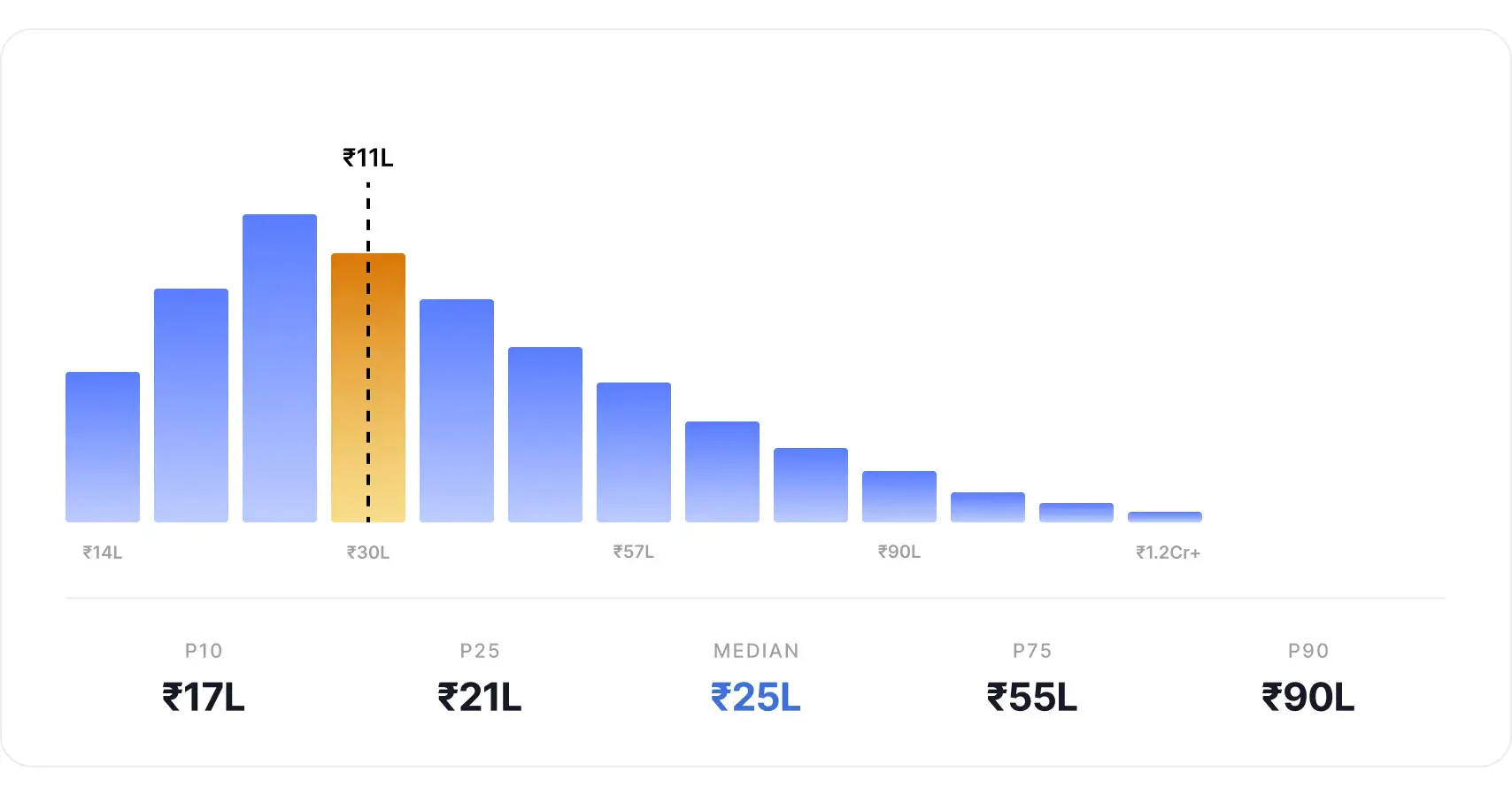
Salary range: ₹14 LPA to ₹1.2 Cr
Technical Lead salaries in India range from ₹14 LPA at IT services firms to ₹1.2 Cr at FAANG in 2026. The national median sits around ₹25 LPA, but the services-to-product gap at this level is one of the widest in all of engineering.
Quick salary snapshot
- First-time Tech Lead at IT services (5-7 years): ₹14 to 22 LPA
- First-time Tech Lead at product company or GCC: ₹25 to 40 LPA
- Senior Tech Lead at Amazon or Flipkart (10 years): ₹60 to 75 LPA
- FAANG: up to ₹1.2 Cr total compensation
What moves the number
- A switch from IT services to a product company at the Tech Lead level commonly triggers a 40 to 80% salary reset
- Product companies pay 40 to 60% more at the initial Tech Lead level and 3 to 5x more at the senior end
- The sharpest jump happens when engineers move from senior IC roles into architecture-owning lead positions
- AI and system design depth add a direct premium at product companies and GCCs in 2026
One thing that confuses people about this title
The Tech Lead title means different things at different companies.
- At IT services firms: a delivery and people-management role, typically at 6 to 10 years
- At product companies: a senior IC role with full architecture ownership and minimal direct reports, typically at 5 to 8 years
The same title, two different jobs. Pay reflects that difference.
City
Bengaluru leads on pay for Tech Lead roles. Hyderabad is a strong second for GCC hiring. Both pay significantly above the national median.
Technical Lead Salary Range in India; 2026 Breakdown
Technical Leads own architecture decisions, drive code quality standards, and mentor engineers while remaining hands-on with delivery. In 2026, the Indian market ranges from ₹14 LPA for Tech Leads at IT services firms to ₹1.2 Cr at FAANG. The national median sits around ₹25 LPA, but the services-to-product gap at this level is one of the widest in all of engineering.


.svg)
.svg)
Technical Lead Salary by Experience Level in India
The Tech Lead title is applied inconsistently across companies; it maps to 6-10 years in IT services, but 5-8 years at product companies. The sharpest compensation jump happens when engineers transition from senior IC roles into architecture-owning lead positions. The gap between services and product companies widens with seniority.

Which Industries Pay Technical Leads the Most in India?
FAANG and global product companies set the ceiling because Tech Leads at these firms own systems that serve millions of users and directly impact revenue. Fintech and SaaS companies follow closely due to the regulatory, reliability, and scale demands of their platforms.
Technical Lead Salary by City
Bangalore leads with a 20-25% premium over other metros for Tech Lead roles, driven by product companies and startup engineering hubs. Hyderabad has narrowed the gap significantly as GCCs have large Indian engineering teams there. Remote roles at global product firms continue to mirror the hiring company's HQ salary band.

Related Roles
Similar roles you might consider

What Affects Pay
What influences anTechnical Leadsalary
Six factors explain most of the variance inTechnical Lead in India. Mix matters more thanany single one.

Years of Experience
Steep jumps at the 5-year (first lead role) and 10-year (senior lead/architect) marks. Averages: ₹18-25 LPA at 5-7 years, ₹30-45 LPA at 7-10 years, ₹50+ LPA at 10+ years in product companies.

Company Type
Product companies and GCCs pay 40-60% more than IT services firms, and at FAANG, the gap widens to 3-5x. The services ceiling at ₹30-45 LPA for senior Tech Leads is where product companies' mid-band begins.

Location Tier
Bangalore pays 20-25% above the national average for Tech Lead roles. Hyderabad and Delhi NCR are 10-15% lower but offer better cost-of-living ratios. Tier-2 cities lag by 20-30%, though remote roles are erasing this gap.

Domain Specialization
Fintech (payments, lending, trading systems), cloud infrastructure, and AI/ML platform leads command 25-40% premiums over domain-agnostic Tech Leads. Regulatory and compliance complexity in fintech and BFSI further inflates this premium.

Architecture & System Design
Tech Leads who own distributed systems, high-availability architecture, or platform-level infrastructure are compensated meaningfully higher than those managing feature delivery teams. This is often the difference between ₹30 LPA and ₹55+ LPA.

Equity Component
At FAANG and funded startups (Series B+), equity becomes the dominant compensation. Annual RSU vesting at Google, Microsoft, or Amazon can match or exceed the base salary. At Series B/C startups, ESOP grants of 0.05-0.5% are common, with meaningful upside on a liquidity event.
Frequently Asked Questions
At IT services firms, a first-time Tech Lead (5-7 years of experience) typically earns ₹14-22 LPA. At product companies and GCCs, the same transition lands at ₹25-40 LPA. Switching from services to a product commonly triggers a 40-80% salary reset.
Product companies pay 40-60% more at the initial Tech Lead level and 3-5x more at the senior end. A 10-year Tech Lead at TCS or Infosys earns ₹28 LPA, and a counterpart at Amazon or Flipkart earns ₹60-75 LPA.
At IT services firms, Tech Lead is typically a delivery and people-management role. At product companies, it's often a senior IC role with ownership of architecture and minimal direct reports. GCCs tend to split it explicitly: Tech Lead (IC) and Engineering Manager (people).
Yes, but only at FAANG-tier companies and primarily through equity. Base salaries for Tech Leads rarely cross ₹55-60 LPA. Total comp of ₹1 Cr+ requires positions at Google, Microsoft, or Amazon India with significant RSU vesting, typically at 10-12+ years of experience.
Switch from a services company to a product company or GCC. This single move delivers the largest immediate salary jump (40-80% is typical). Beyond that, deepening system-design and architecture skills, picking up a high-demand domain (fintech, cloud infra, AI/ML platforms).
