
Salary Calculator
What is theComputer Vision Engineersalary in India?
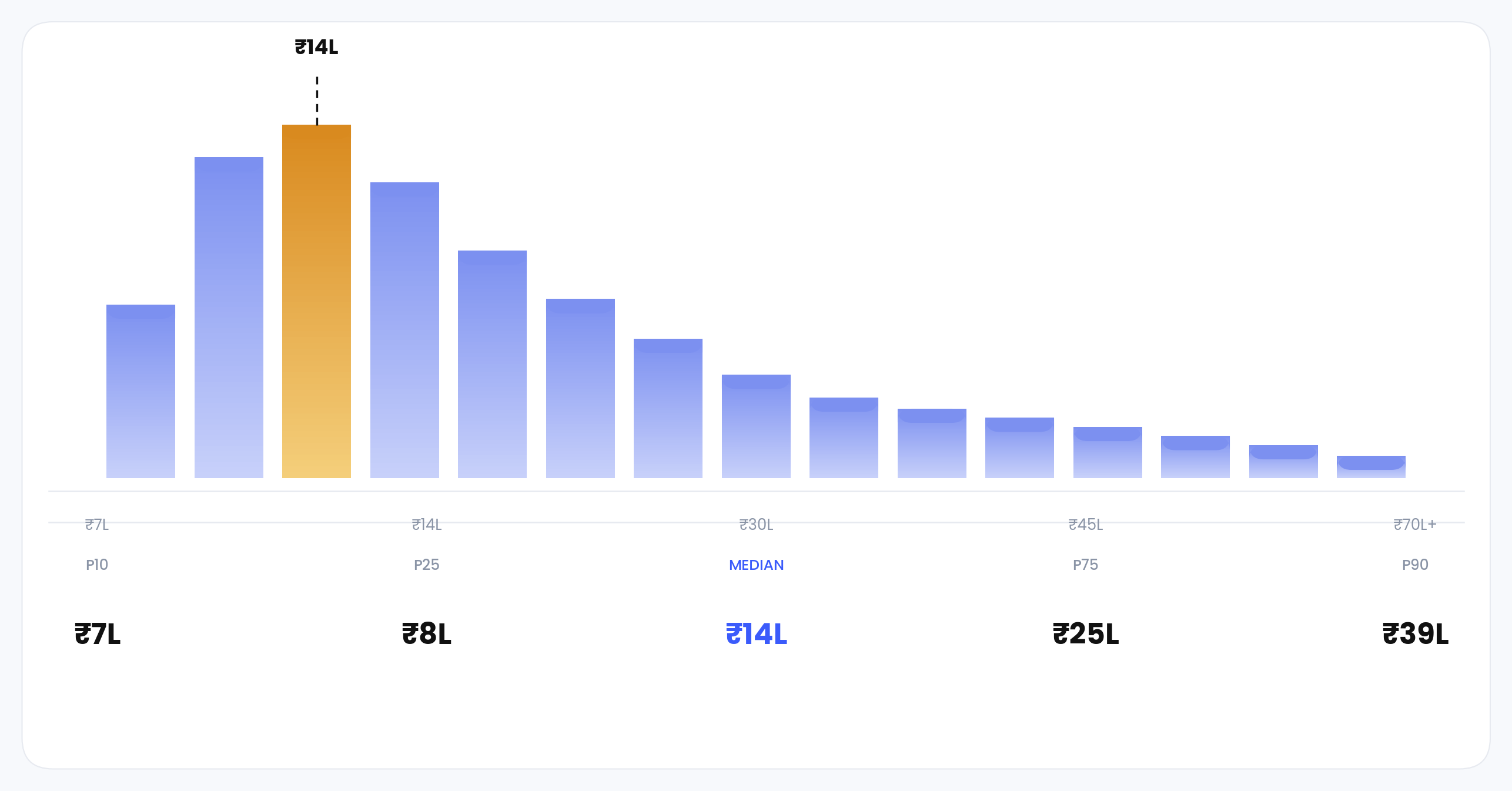
Computer Vision Engineer salaries in India range from ₹7 LPA to ₹70 LPA in 2026. Application domain, research depth, and company type are the primary pay drivers. The market spans ₹7 LPA for freshers at IT services firms to ₹70 LPA for principal engineers and researchers at semiconductor firms and FAANG AI labs. The sharpest salary jumps happen between 2 and 5 years, when engineers move from assisting with basic image processing to designing novel architectures and owning end-to-end vision pipelines.
The spread in this field is wider than most engineering roles because domain and research depth matter more than experience alone. Two engineers with the same years of experience, one deploying object detection for an e-commerce catalogue and one building real-time scene understanding for autonomous vehicles, are doing fundamentally different technical work. Their salaries reflect that.
What drives pay at this level:
Application domain is the single biggest variable. Autonomous vehicles and ADAS pay the most because the engineering constraints are the hardest: models must run at strict latency on embedded hardware and the failure cost is high. Semiconductor firms like Qualcomm, Intel, and NVIDIA follow closely because they hire researchers, not just engineers, and pay accordingly. Real-world deployment complexity is a direct salary multiplier. At IT services firms, CV work is typically project execution. At product companies, engineers own model performance with measurable business outcomes. That difference drives a consistent 40 to 60% pay gap between the two.
Research depth is a bigger lever here than in most other engineering roles. A Master's or PhD adds 15 to 25% at research-oriented employers. Published work at NeurIPS, CVPR, or ICCV directly affects offer levels at semiconductor firms and AI labs. This is one of the few engineering roles in India where academic credentials translate into a measurable salary premium well into mid-career.
Bengaluru pays 20 to 25% above the national average, anchored by semiconductor R&D centres and AI-first product companies. Pune is the strongest secondary market specifically for automotive computer vision, with Bosch, Continental, and Mobileye India all actively hiring there.
What the Computer Vision Engineer market actually pays in India
Computer Vision Engineers build and deploy algorithms that let machines interpret visual data. Like object detection, image segmentation, video tracking, facial recognition, and real-time scene understanding. The market spans ₹7 LPA for freshers at IT services firms to ₹70 LPA for principal engineers and researchers.


.svg)
.svg)
Experience vs pay: The computer vision engineer curve
The sharpest salary jumps in this field happen between 2 and 5 years. When engineers move to designing novel architectures and owning end-to-end vision pipelines. Senior engineers who have deployed computer vision systems at production scale in safety-critical or high-throughput domains command the highest premiums.

Which industries pay computer vision engineers the most
Autonomous vehicles and semiconductors pay the highest premiums for computer vision talent. Because real-time, safety-critical visual processing has near-zero tolerance for error, which directly narrows the pool of engineers who can operate at that level.
Where in India computer vision engineers earn the most
Bangalore concentrates the largest share of computer vision hiring, driven by semiconductor R&D centres, AI-first startups, and global product companies. Pune is a notable secondary hub for automotive computer vision work; Bosch, Continental, and several ADAS-focused R&D labs operate large engineering teams there.

Related Roles
Similar roles you might consider

What Affects Pay
What influences anComputer Vision Engineersalary
Six factors explain most of the variance inComputer Vision Engineer in India. Mix matters more thanany single one.

Years of Experience
Freshers average ₹8 LPA; mid-level (2-5 years) ₹15 LPA; senior (5-8 years) ₹26 LPA; lead/principal (8+) ₹36 LPA. Engineers who own production deployments move through bands faster than those confined to research sandboxes.

Application Domain
ADAS and semiconductor roles pay 30-35% above the national average; manufacturing and IT services sit at or below it. What you apply computer vision to matters as much as how well you apply it. Safety-critical and real-time domains command the steepest premiums.

Research vs Production Deployment
Engineers who deploy models into production systems handling latency, hardware constraints, and inference optimization earn 20-30% more. Real-world deployment complexity is a direct salary multiplier.

Company Type
Semiconductor firms (Qualcomm, Intel, NVIDIA) and global product companies pay 40-60% more than IT services firms. At IT services, computer vision work is often project execution; at product companies, engineers own model performance with measurable business outcomes.

Geographic Location
Bangalore pays 20-25% above the national average, anchored by semiconductor R&D and AI-first product companies. Pune is the strongest secondary market for automotive computer vision roles, with Bosch, Continental, and Mobileye India.

Degree and Published Research
Computer Vision is one of the few engineering fields in India where a Master's or PhD translates typically 15-25% at research-oriented employers. Published papers in NeurIPS, computer visionPR, or ICcomputer vision directly affect offer levels at semiconductor firms and AI labs.
Frequently Asked Questions
Yes, entry-level computer vision engineers earn ₹7-10 LPA. This is among the highest starting packages across any engineering discipline in India. The talent supply remains thin relative to demand, particularly for engineers who can handle real-time deployment and safety-critical systems. Salaries grow sharply with domain depth.
Qualcomm, Intel, NVIDIA, Samsung R&D, and Mobileye India are the highest-paying employers for computer vision engineers. They typically offer ₹25-70 LPA for mid-to-senior profiles. Among Indian companies, Adobe's AI research team, Flipkart AI, and Swiggy's computer vision group are strong payers at ₹20-45 LPA for senior roles.
More than in most engineering disciplines, yes. Research-oriented employers, particularly semiconductor companies and AI labs, treat PhD candidates as a separate hiring tier with structured salary premiums of 15-25%. Published research in top computer vision conferences carries measurable weight in offer negotiations.
Autonomous vehicles and ADAS pay the most, followed by semiconductor and hardware roles, then healthcare AI. Manufacturing and industrial vision sit closer to the national average because the technical complexity, while real, involves less real-time safety-critical processing than automotive applications.
At junior levels, salaries are comparable, both average ₹8-10 LPA at entry. Senior computer vision engineers in specialised domains (ADAS, medical imaging) can earn 15-25% more. Because of the narrower talent pool and application-specific depth required. Generalist ML engineers typically have a wider job market but a lower salary ceiling at equivalent experience.
