
Salary Calculator
What is theTechnical Product Managersalary in India?
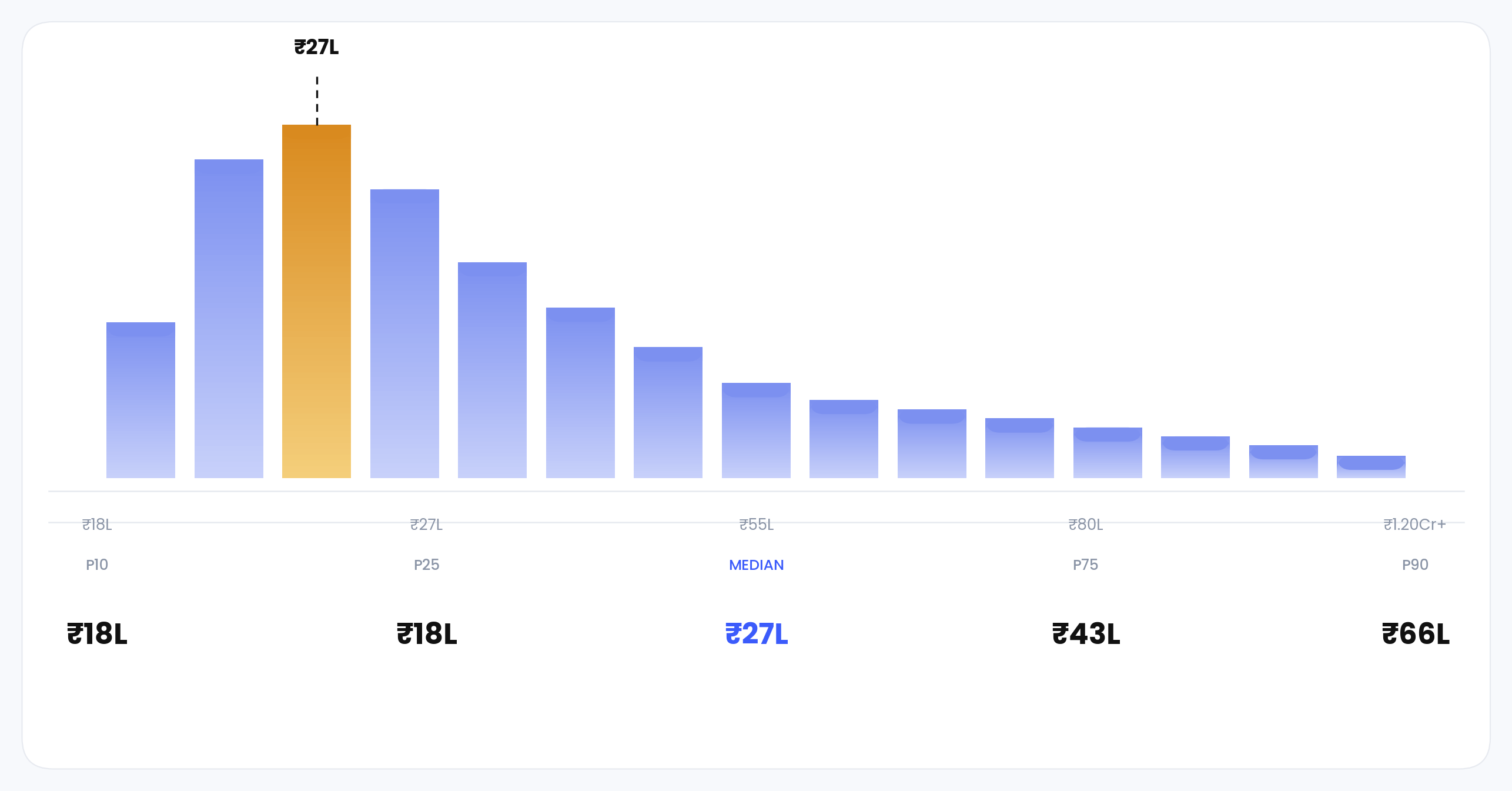
Technical Product Manager salaries in India range from ₹18 LPA to ₹1.2 Cr in 2026. Technical depth, product domain, and company tier are the three biggest pay drivers. Junior TPMs entering from engineering or APM tracks average ₹18 LPA. Mid-level TPMs at 2 to 5 years average ₹28 LPA. Senior TPMs at 5 to 8 years average ₹47 LPA. At 8 or more years, principal and group TPMs at FAANG offices average ₹68 LPA in cash, with RSUs frequently pushing total compensation above ₹1 Cr.
TPM roles command 15 to 25% more than general PM roles at equivalent seniority. The difference is technical depth: TPMs own products at the intersection of engineering and business, APIs, data platforms, developer tools, infrastructure, and complex B2B systems. That scope justifies the pay gap. The largest single jump in the TPM career happens between 2 to 5 years and 5 to 8 years, particularly for those who take on platform or developer-facing product ownership.
What drives pay at this level?
Product domain is the biggest variable. Developer tools, platform infrastructure, and fintech pay the most because the engineering complexity and business stakes are highest. These are the domains where technical product gaps have the most direct business consequences, creating genuine scarcity for TPMs who can operate at that depth. Company tier follows closely: FAANG and unicorns pay significantly more than IT services firms for the same title. Salary jumps are tied to scope of ownership and the degree of independence with which roadmap decisions are made.
Where technical product managers land in India
Technical Product Managers own products that sit at the intersection of engineering and business APIs, data platforms, developer tools, infrastructure, and complex B2B systems. TPM roles command 15-25% more than general PM roles at equivalent seniority. The market spans ₹18 LPA for junior TPMs to over ₹1.2 Cr at the senior and principal levels.


.svg)
.svg)
How technical product manager salary grows with experience
The move from 2-5 years to 5-8 years is where the largest single jump occurs. Particularly for those who take on platform or developer-facing product ownership. Salary jumps in the TPM career are tied to scope of ownership, and the degree of independence with which roadmap decisions are made.

Industry-wise salary of technical product managers
Developer tools, platform infrastructure, and fintech pay the highest premiums. These are the domains where technical product gaps have the most direct business consequences, creating genuine scarcity for TPMs who can operate at that depth.
Location-wise salary of technical product managers
Bangalore is the undisputed hub for TPM hiring in India. The concentration of product-first companies, FAANG engineering centres, and well-funded startups means both the highest salaries and the most active hiring market. Hyderabad is closing the gap fast, driven by significant GCC expansions from Apple, Amazon, and ServiceNow.

Related Roles
Similar roles you might consider

What Affects Pay
What influences anTechnical Product Managersalary
Six factors explain most of the variance inTechnical Product Manager in India. Mix matters more thanany single one.

Years of Experience
Junior TPMs entering from engineering or APM tracks average ₹18 LPA at the 0-2 year mark. Mid-level TPMs (2-5 years) average ₹28 LPA. Senior TPMs (5-8 years) average ₹47 LPA. At 8+ years, principal and group TPMs at FAANG offices average ₹68 LPA in cash, with RSUs frequently exceeding ₹1 Cr.

Technical Depth
The ability to read architecture diagrams, write detailed API specifications, participate meaningfully in system design reviews, and evaluate engineering trade-offs directly determines compensation. TPMs who can operate at this depth command a 15-25% premium over general PMs at equivalent seniority levels.

Company Type
FAANG offices in India pay 30-50% more than Indian startups for the same TPM seniority. A TPM with 5-8 years of experience earns ₹40-70 LPA cash at a tier-1 Indian unicorn. And ₹60-120 LPA total compensation at a FAANG company when RSUs are included.

Product Domain
Platform, API, and developer tools TPMs earn consistently more than consumer product or growth PMs. TPMs owning payment infrastructure, data platforms, or developer SDKs at fintech and B2B SaaS companies sit in the top 25% of the salary band across all experience levels.

Geographic Location
Bangalore pays 20-25% above the national average for TPM roles, anchored by the density of product-first companies and global engineering centres. Hyderabad is increasingly competitive, with GCC expansions from Apple, Amazon, and ServiceNow.

Equity Component
At FAANG companies, RSUs can add ₹30-60 LPA in annual vesting to a base of ₹60-80 LPA. At tier-1 unicorns and Series C+ startups, ESOPs at the 5-8 year mark can add ₹15-30 LPA in notional annual value. Negotiating total composition is essential at this seniority.
Frequently Asked Questions
A TPM is expected to have working knowledge of APIs, system design, data pipelines, and cloud architecture. This technical fluency allows TPMs to write detailed technical specifications, challenge engineering trade-offs, and own products where the end user is often a developer or engineer.
Not necessarily, many successful TPMs come from engineering backgrounds, and some transition from strong non-technical PM roles by building technical skills deliberately. However, the ability to demonstrate technical credibility through work experience, system design knowledge, or API fluency is non-negotiable.
Google, Amazon, Microsoft, Meta, and Atlassian consistently pay the most typically ₹60-1.2 Cr total compensation at senior levels. Among Indian companies, Razorpay, PhonePe, Flipkart, Postman, and CRED are the top payers for mid-to-senior TPM profiles, with ranges of ₹40-80 LPA for 5-8 years of experience.
An MBA from IIM, ISB, or XLRI can accelerate early-career entry into PM tracks, particularly at companies with structured APM programmes. However, for the technical product manager path specifically, a strong engineering background combined with demonstrated product ownership tends to be valued more.
At FAANG companies, RSUs typically add ₹30-60 LPA in annual vesting value on top of a base salary of ₹60-80 LPA for senior TPMs. At Series C+ unicorns and high-growth startups, ESOPs at the 5-8 year mark add a notional ₹15-30 LPA annually, with meaningful upside at pre-IPO stage companies.
