
Salary Calculator
What is theSoftware Engineersalary in India?
I already have Recrew's Software Engineer page content from earlier searches. Here's the key takeaways draft.
Software Engineer Salary in India 2026
Salary range: ₹3.5 LPA to ₹1.5 Cr
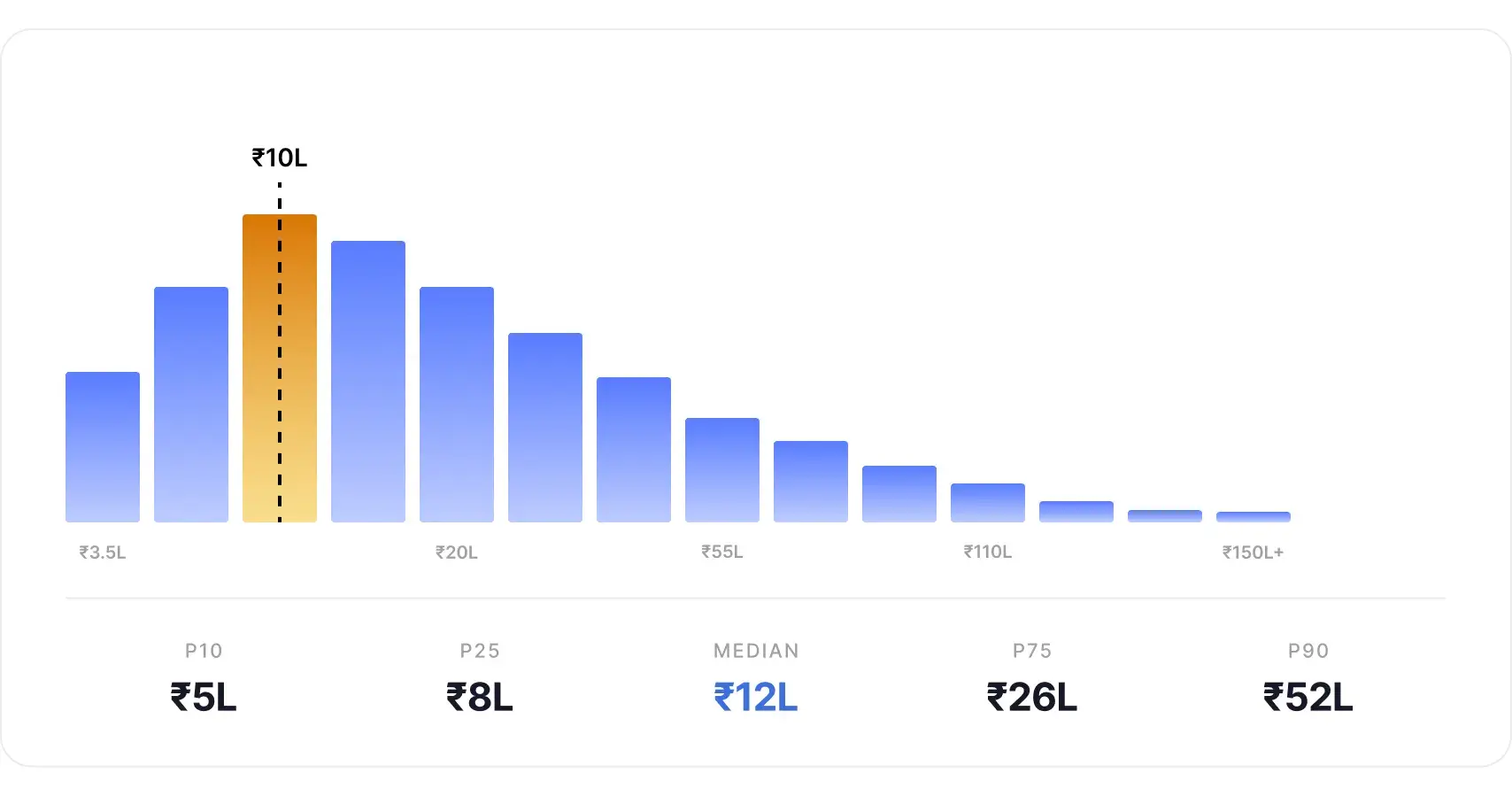
Software Engineer salaries in India range from ₹3.5 LPA to ₹1.5 Cr in 2026. The single biggest predictor of where you land is not years of experience. It's company type.
Quick salary snapshot
- IT services firms: ₹3.5 to 25 LPA across all experience levels
- Product companies and FAANG: 3 to 5x more than IT services for the same experience
- National median across all levels: ₹9 to 12 LPA
- Total comp of ₹1 Cr or more: requires 8 to 12 years, strong system design skills, and roles at companies with meaningful RSU or ESOP programs
What moves the number
- The steepest salary jumps happen at the 2-year and 5-year marks for engineers who move to product companies early
- AI/ML and GenAI/LLM expertise command 30 to 50% premiums over generalist profiles in 2026
- Cloud-native skills (AWS, GCP, Azure), distributed systems, and platform engineering also add meaningful premiums
- IIT and NIT graduates start 20 to 30% higher, but that advantage largely disappears by the 4 to 5 year mark. After that, skills and track record dominate
- Strong portfolios from self-taught or bootcamp engineers regularly land ₹8 to 18 LPA at product companies
- From the 5-year mark at funded startups, annual equity vesting can match or exceed base salary
One thing most people underestimate
Base salaries rarely cross ₹50 to 60 LPA even at senior levels. The jump to ₹80 LPA or more is almost always driven by RSUs and ESOPs, not cash. If you're evaluating offers without factoring equity, you're comparing the wrong number.
City
Bengaluru pays 15 to 20% above the national average. Hyderabad has closed the gap with large Microsoft, Amazon, Google, and Apple engineering teams. Remote roles at global product firms pay to the hiring company's HQ band regardless of city.
Software Engineer Salary Range in India: 2026 Breakdown
Software Engineers in India earned between ₹3.5 LPA and ₹1.5 Cr in 2026. The single biggest predictor of where you land isn't years of experience, but it's company type. IT services firms pay ₹3.5-25 LPA. Product companies and FAANG labs pay 3–5x more (base + equity + bonuses) for the same experience level. The median across all experience levels sits around ₹9-12 LPA.


.svg)
.svg)
Software Engineer Salary by Experience Level in India
The steepest salary jumps occur at the 2 and 5-year marks for engineers who move to product companies early. Senior-level data show greater variance due to the RSU and ESOP components inflating reported CTC figures. The fresher market in 2026 is the most bifurcated it has been; the gap between the bottom 25% and top 25% campus offers is nearly 8x.

Which Industries Pay Software Engineers the Most in India?
Product-first SaaS companies and fintech firms pay the highest premiums because they directly drive product revenue and user growth. IT services firms, which bill clients hourly and pocket the margin, consistently sit at the bottom of the compensation range for equivalent experience.
Location-wise Salary of Software Engineers
Bangalore commands a 15-20% salary premium over other metros, driven by its density of SaaS firms, product startups, and MNC engineering hubs. Hyderabad has closed the gap meaningfully as Microsoft, Amazon, Google, and Apple all have large or comparable engineering teams there. Remote roles at global product firms generally mirror the hiring company's HQ salary band, making metro-equivalent pay accessible regardless of location.

Related Roles
Similar roles you might consider

What Affects Pay
What influences anSoftware Engineersalary
Six factors explain most of the variance inSoftware Engineer in India. Mix matters more thanany single one.

Years of Experience
Experience is the strongest salary driver. Steep jumps occur at the 2-year and 5-year marks. Progression from junior to senior to staff levels can multiply total compensation by 5-10x. Experience band is the most predictive factor after company type.

Company Type
Product companies and unicorns pay 40-60% more than IT services firms for equivalent experience. At FAANG, this gap widens to 3-5x over services. The business model (revenue per engineer vs. hourly billing) drives this split entirely.

Location
Bangalore-based roles pay 15-20% above the national average. Hyderabad and Pune trail by 10-15% but offer better cost-of-living ratios meaningfully. Tier-2 cities run 15-25% lower across every level.

Tech Stack & Specialization
Engineers with AI/ML, GenAI/LLM, cloud-native (AWS/GCP/Azure), or distributed systems expertise command 30-50% premiums over generalist profiles. System design depth increasingly separates mid-level from senior offers.

Education & Credentials
IIT/NIT graduates receive 20-30% higher initial offers, but the college brand effect diminishes rapidly after 2-3 years. By 4-5 years, individual skills and track record dominate. Strong portfolios from self-taught or bootcamp engineers can land ₹8-18 LPA at product companies.

Equity Component
At FAANG and funded startups (Series B+), ESOPs and RSU vesting become significant from the 5-year mark. At senior levels, annual equity vesting can match or exceed base salary, pushing total comp to ₹60-80 LPA or beyond.
Frequently Asked Questions
Freshers at IT services firms (TCS, Infosys, Wipro) typically earn ₹3.5-7 LPA. Product companies and startups offer ₹6-15 LPA for the same experience level. Top campus offers from FAANG for premier institute graduates can reach ₹25-45 LPA ( fewer than 1% of hires).
Product companies pay 40-60% more at mid-level and 3-5x more at senior levels. The gap is that structural services firms bill clients hourly and cap engineer pay tightly. While product companies monetise each engineer at multiples of that.
Yes, but only at FAANG-tier companies or late-stage unicorns, and primarily through equity. Base salaries rarely cross ₹50-60 LPA. Total comp of ₹1 Cr+ requires 8-12+ years of experience, strong system design skills, and roles at companies with meaningful RSU/ESOP programs.
Bangalore still pays the highest absolute numbers with a 15-20% premium. However, Hyderabad has closed the gap and offers a 25-30% lower cost of living. A ₹40 LPA offer in Hyderabad often yields higher take-home purchasing power than a ₹45 LPA offer in Bangalore.
AI/ML and GenAI/LLM expertise currently command the steepest premiums with 30-50% above generalist profiles. Cloud-native skills (AWS, GCP, Azure), distributed systems, and platform engineering follow closely.
