
Salary Calculator
What is theDeep Learning Engineersalary in India?
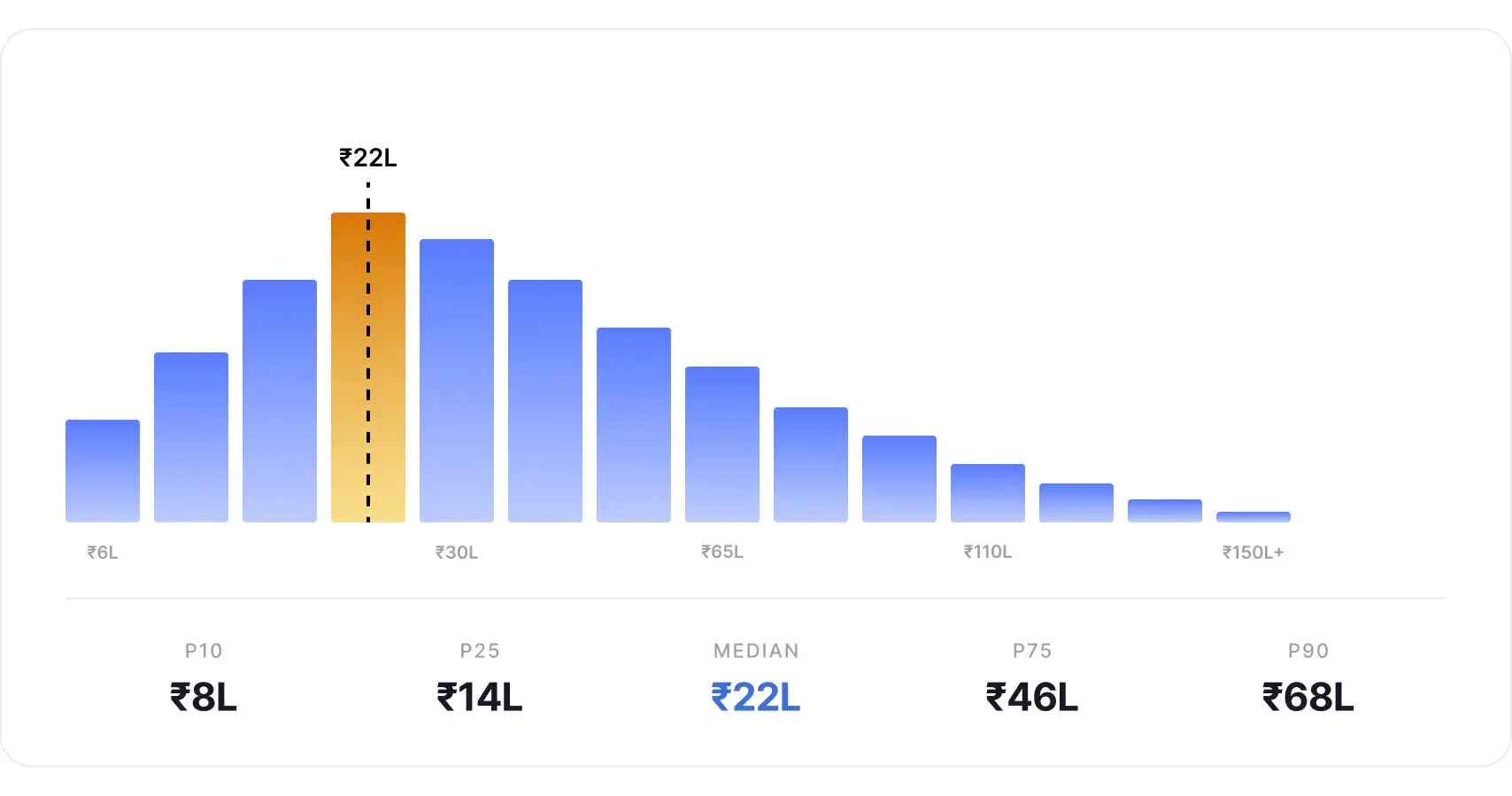
Salary range: ₹22 LPA to ₹1.5 Cr+
Deep Learning Engineer salaries in India range from ₹6 LPA at entry level in IT services to ₹1.5 Cr or more for principal-level engineers at FAANG and AI research labs. The typical mid-to-senior range sits between ₹22 LPA and ₹150 LPA.
Quick salary snapshot
- Entry level: ₹6 to 12 LPA
- Mid-level (2-5 years): most aggressively bid-on cohort in 2026, routinely fielding 5 to 7 offers with switch jumps of 50 to 80%
- Senior (5-8 years): ₹45 to 80 LPA at product companies and GCCs
- Principal (8+ years): ₹95 LPA to ₹1.3 Cr cash plus RSUs at top companies
What moves the number
- Sub-specialisation is the biggest pay driver. Applied research (foundation-model training, RLHF, DPO, post-training) is the highest-paid track in 2026
- Engineers with distributed training skills (DeepSpeed, FSDP) and GPU optimisation (CUDA, mixed-precision) earn 15 to 25% more than generalists
- Company type creates a 60 to 150% gap between IT services and product companies at equivalent experience
- The 2-year and 5-year marks are the two biggest salary jump points. At 5 years, specialisation depth separates mid-level from senior offers more than tenure does
One thing to know
Engineers with foundation-model or post-training experience at 8 or more years are the scarcest technical profile in India relative to demand right now. That scarcity is reflected directly in compensation at the top end.
City
Bengaluru pays 25 to 30% above other metros for deep learning roles and is the only Indian city with a full research infrastructure ecosystem. Hyderabad is within 5 to 10% for GCC roles but trails on startup and frontier research hiring.
Deep Learning Engineer Salary Range in India; 2026 Breakdown
Deep Learning Engineers design, train, and deploy neural network systems, CNNs, transformers, diffusion models, GANs, and foundation models. In 2026, the Indian market ranges from ₹6 LPA at the entry level in IT services to ₹1.5 Cr+ for principal-level engineers at FAANG and AI research labs.


.svg)
.svg)
Deep Learning Engineer Salary by Experience Level in India
Mid-level engineers (2-5 years) with production LLM or computer vision experience are the most aggressively bid-on cohort in 2026, routinely fielding 5-7 simultaneous offers with switch jumps of 50-80%. At 8+ years, engineers with foundation-model or post-training experience are the scarcest technical profile in India relative to demand.

Which Industries Pay Deep Learning Engineers the Most in India?
AI research labs and foundation-model companies set the absolute ceiling. They need engineers who can train, fine-tune, and serve large neural networks at scale. Fintech and autonomous systems follow closely due to regulatory precision and safety-critical requirements.
Deep Learning Engineer Salary by City
Bengaluru's premium for deep learning roles is significantly higher than for general software engineering. For research-adjacent DL roles, Bengaluru is the only realistic market in India. Remote roles for US/EU-based AI companies pay at Bengaluru benchmarks or above, working remotely from India.

Related Roles
Similar roles you might consider

What Affects Pay
What influences anDeep Learning Engineersalary
Six factors explain most of the variance inDeep Learning Engineer in India. Mix matters more thanany single one.

Years of Experience
Steep jumps at the 2-year (first product company switch) and 5-year (senior specialist) marks. Entry: ₹8-12 LPA, Mid-level (2-5 years): ₹20-35 LPA, Senior (5-8 years): ₹40-60 LPA. At 8+ years, engineers with foundation-model depth at GCCs reach ₹95 LPA plus RSUs.

Company Type
The single largest structural salary determinant. Product companies and GCCs pay 60-150% more than IT services firms at equivalent experience. FAANG AI labs and research divisions set the absolute ceiling at ₹65 LPA - ₹1.5 Cr+.

Location
Bangalore's DL salary premium runs higher than the general software engineering premium; roughly 25-30% above other metros. Hyderabad is within 5-10% for GCC roles. For research-adjacent DL roles, Bangalore is effectively the only Indian market.

Specialization Depth (DL Sub-domain)
Foundation-model training and post-training (RLHF, DPO, supervised fine-tuning), LLM serving infrastructure (vLLM, TGI, Triton, KV-cache optimization). Applied research is the highest-paid sub-specialization in 2026.

Framework & Infrastructure
PyTorch is the current production standard at most Indian product companies and GCCs. Beyond frameworks, skills in distributed training (DeepSpeed, FSDP), model serving (Triton, vLLM), and GPU optimization (CUDA, mixed-precision) command an additional 15-25% premium.

Production vs. Research vs. Integration
Engineers who train, optimize, and deploy models in production consistently. At IT services firms, many "deep learning" roles are actually API integration, calling pre-built models rather than training custom architectures.
Frequently Asked Questions
Deep Learning Engineers specialize in neural network architectures: transformers, CNNs, GANs, and diffusion models. General ML Engineers work across a broader toolkit, including classical algorithms (random forests, XGBoost, linear models). The DL specialization pays 25-35% more than classical ML.
Freshers at IT services firms earn ₹6-10 LPA for DL-adjacent roles. Product companies and GCCs offer ₹10-18 LPA for entry-level DL engineers with strong portfolios, PyTorch proficiency, and at least one deployed project. IIT/NIT graduates with research exposure entering FAANG India directly can start at ₹15 LPA+.
For research-track roles (or published papers at top venues like NeurIPS, ICML, CVPR) is almost a prerequisite and directly impacts the starting band.
For production DL roles at product companies and GCCs, a PhD is not required. Demonstrated systems experience and a portfolio of deployed models matter more.
Yes, Senior DL engineers (8-12 years) at GCCs and AI-first startups reach ₹95 LPA-₹1.3 Cr cash plus RSUs. Principal-level engineers at FAANG AI labs reach ₹1.5-2 Cr total comp. These roles require foundation-model training experience, published research, or deep LLM infrastructure expertise, not general deep learning proficiency.
PyTorch- It's the current production standard at most Indian product companies, GCCs, and AI research labs. TensorFlow still exists in legacy enterprise deployments. Beyond frameworks, distributed training (DeepSpeed, FSDP) and model serving (Triton, vLLM) skills carry additional salary premiums of 15-25%.
